
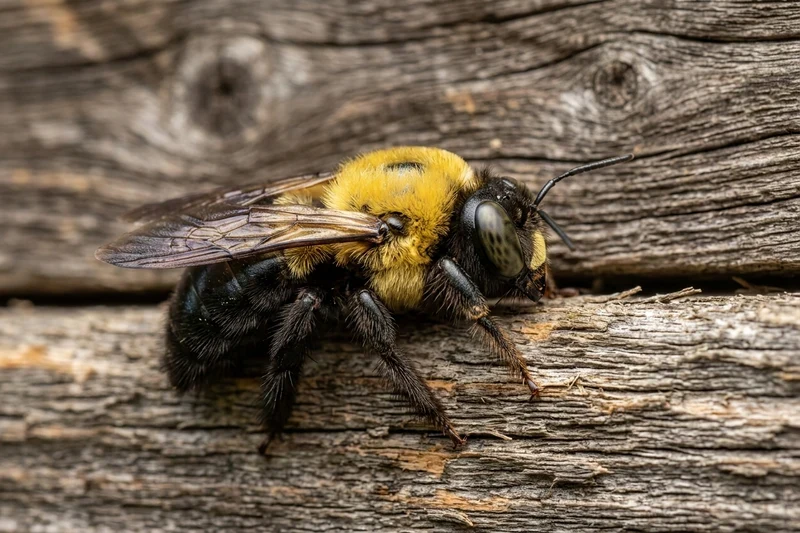
Carpenter Bees Control & Extermination Services
Your Home In Safe Hands: Verified matching platform connecting homeowners with independent licensed pest specialists. ServiceFind does not perform application work directly.
Carpenter bees look like large bumblebees but have shiny, hairless abdomens. They bore into wood to lay eggs, favoring bare, unpainted softwoods.
How to Eliminate Carpenter Bees Safely & Permanently
Effective carpenter bee control begins with species identification and source elimination. Licensed professionals deploy targeted, low-toxicity transfer baits, micro-dusting, and physical exclusion.
⚠️ Common Signs of Carpenter Bees
- •Round, clean-drilled holes in bare wood (about 1/2 inch)
- •Sawdust piles under eave or deck edges
- •Large bees hovering near wooden structures in spring
- •Streaks of bee droppings or wood staining under holes
🚨 Health & Property Risks
- •Allergen and bacteria contamination of food prep areas
- •Structural timber excavation or electrical wiring damage
- •Secondary skin bite reactions and sleep disruption
Certified Treatment & Exclusion Methods
Explore Related Pests
Professional Pest Control Video Guides
Visual walkthroughs of certified inspection methods, biological treatments, and structural exclusion.
Professional Pest Control Inspection Protocols
Watch certified technicians inspect attic insulation, crawlspaces, and foundation perimeters using thermal imaging.
Integrated Pest Management & Targeted Baits
How non-repellent transfer chemistry and biological growth regulators eliminate colonies at the source.
Structural Exclusion & Entry Point Fortification
Complete guide to sealing foundation weep holes and roofline dormers with galvanized steel mesh.
Compare Top Pest Control Providers
Independent benchmark comparison of certified national and regional pest control operators.
| Provider | Average Cost | Warranty Scope | Customer Rating | Coverage Areas | Action |
|---|---|---|---|---|---|
Terminix 14,200 verified reviews | $450 avg | ✓ 12 Months Re-Service | ★4.8 / 5.0 | Nationwide, 50 States | Get Fair Quote → |
Orkin 18,500 verified reviews | $495 avg | ✓ 12 Months Re-Service | ★4.7 / 5.0 | Nationwide, 48 States | Get Fair Quote → |
Rentokil 9,800 verified reviews | $480 avg | ✓ 12 Months Re-Service | ★4.6 / 5.0 | Nationwide, 46 States | Get Fair Quote → |
Truly Nolen 6,400 verified reviews | $430 avg | ✓ 12 Months Re-Service | ★4.7 / 5.0 | Regional, Sunbelt States | Get Fair Quote → |
Aptive Environmental 11,200 verified reviews | $420 avg | ✓ 12 Months Re-Service | ★4.5 / 5.0 | 35+ States, Eco-Conscious Focus | Get Fair Quote → |
Frequently Asked Questions
Everything you need to know about professional pest control, licensing, pricing, and treatment safety.
Ready for honest, eco-friendly help?
Free to use. We match you with independent, licensed, eco-friendly local providers — no pressure, no obligation.
Free to use · No obligation